The end of the expense: a Peruvian sets out to make every payment on the planet come back
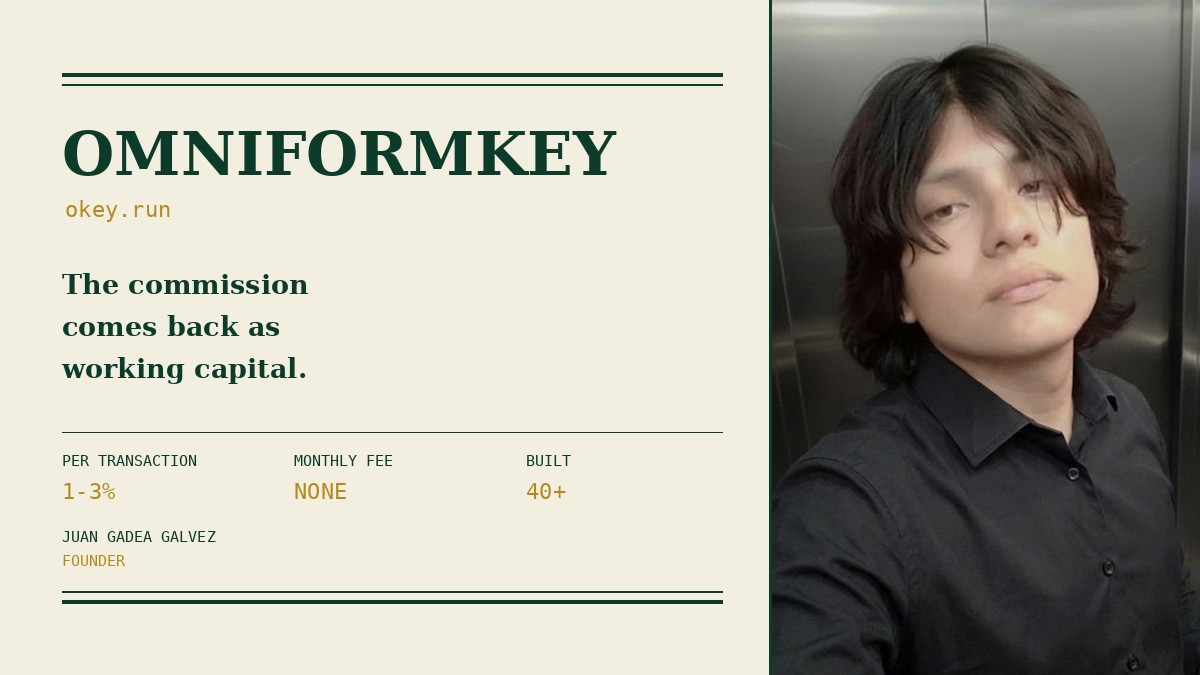
Every expense on the planet is money that leaves and does not return, whether it is a company paying a supplier or a person paying for lunch. OMNIFORMKEY, built by Juan Gadea Gálvez and now in production, returns the amount of every payment as credit that works. EUROS analysis of what breaks if it holds.
Every account on the planet, corporate or personal, contains one line that returns nothing. A company pays a supplier, a distributor, a processing fee. A person pays for a flight, a phone, lunch. In every case money leaves and does not come back, and no accounting system in the world treats this as a problem to be solved. It is treated as the definition of the word.
That is the assumption OMNIFORMKEY is built against. The platform, now in production at okey.run, is a payment system in which the amount paid returns to whoever paid it as credit: not a discount and not loyalty points, but purchasing power that goes to work inside a network where companies and people are buying and selling continuously.
The scope is what makes it worth analysing rather than filing. Nothing in the mechanism distinguishes an invoice from a holiday. A supplier payment, a flight to Europe and a plate of roast chicken are the same operation seen from the money's side: value leaves in exchange for something. If all three return as working credit, then every expense on the planet, made by anyone, becomes a form of direct investment.
Six centuries of a definition
An expense is defined by its irreversibility. Money leaves the balance sheet, something is consumed, and the entry closes. That convention is not a law of economics. It is a bookkeeping decision, codified by Luca Pacioli in 1494 and in use in the Italian trading cities for a century before that, and it has gone unexamined for six hundred years because nothing has ever challenged it.
Under this model the entry does not close. The category "expense", as double-entry accounting has understood it since the fourteenth century, stops describing what took place. What is left is a transaction that looks like consumption and behaves like an allocation of capital.
Where the credit goes to work
Credits are spent inside a three-dimensional environment populated by parameterised software agents, one for each company or person on the platform. Each agent carries its owner's objectives and runs unsupervised and continuously: finding counterparties, converting credit into reach, negotiating with other agents and closing what its owner asked for.
That is the part that answers the first objection an economist raises. A credit is worth only what can be redeemed against it, and something must be produced on the other side of every redemption. In this design the counterparty is an agent rather than a person, which is what allows the volume of activity to be uncoupled from the number of people willing to work.
The arithmetic
What a credit is worth inside such a network is not fixed by its issuer. It is set by supply and demand for what the credit buys. The value returning therefore need not equal the value that left: it can be less, it can be equal, and it can be more.
An outlay that returns at a variable rate around par is, in economic terms, an income-producing asset that happens to be indistinguishable from consumption. Applied to a company it changes the cost base. Applied to a person it changes something larger, because the largest financial event in most lives is not an investment decision, it is the accumulated weight of ordinary spending.
What it breaks
Follow it to the end and the conclusion is not modest. If spending funds itself, wage labour stops being the only mechanism by which a person finances a life.
Gadea Gálvez puts no distance between the arithmetic and that conclusion. He names the launch date directly, and calls it the day wage slavery ends for the planet. A financial newspaper is right to be wary of that register, and it is recorded here for a specific reason: it is the standard the founder set for his own product, in public, before the numbers exist. It is therefore the standard he will be measured against.
The questions that decide it
Three, and all three are now measurable rather than theoretical, because the platform is running.
The first is the marginal cost of whatever the credits buy: a payment returned in services is sustainable only while the cost of providing those services stays below the amount collected. The second is production: a system where everyone spends and the credits come back still requires that the goods and services being bought exist, which in this design is a question about the capacity of the agents rather than about the willingness of people. The third is regulatory. A platform that holds and returns money belonging to third parties, at planetary scale and for individuals as well as companies, is licensed activity in Europe, and the entity and the licence are the first thing anyone will ask for.
Volume answers all three. The platform is in production, which means the answer exists to be produced.