Sao Paulo Got One Listing in Five Years, and Nubank Still Trails Itau
B3 went four years and eight months without an IPO before Compass listed in May 2026. Sao Paulo ranks 98th in the Global Financial Centres Index. The post Sao Paulo Got One Listing in Five Years, and Nubank Still Trails Itau appeared first on The Rio Times .
, The stakes. Sao Paulo remains Latin America’s densest financial hub despite a public equities contraction that has seen 21 companies delist from B3 since early 2025., The exchange. B3 held about 358 listed companies at end-2025 with zero IPOs that year. The drought broke on 11 May 2026, when the gas and energy distributor Compass listed and raised about R$3.2bn.
It has been the only one so far. Roughly fifty companies hold the registration needed to follow, and most are waiting for October’s election to pass.
The exchange changed the rules to help. A regime launched in January lets companies with revenue below R$500m list first and sell shares later, with up to two years to complete the offering.
On the ranking that outsiders use, São Paulo sits 98th in the Global Financial Centres Index published in March. Santiago, at 91st, is ahead of it, and Latin America’s average score fell more than any other region’s., The fintech shift. Nubank reported 2025 revenue of US$15.8 billion and 113 million Brazilian customers, making it the largest private financial institution by customer count in Brazil., The money flows. Foreign investors accounted for 60.2 percent of B3 trading participation in February 2026, up from 58.3 percent in 2025., The cost of access. A five-day senior executive trip in the Faria Lima corridor runs US$8,000 to US$14,000 excluding airfare, while luxury hotels charge roughly US$265 to US$600 per night.
São Paulo’s western corridor still concentrates more capital-markets muscle than any rival in Latin America. But the public exchange that anchors that claim is shrinking even as its fintech challengers scale faster than anyone expected.
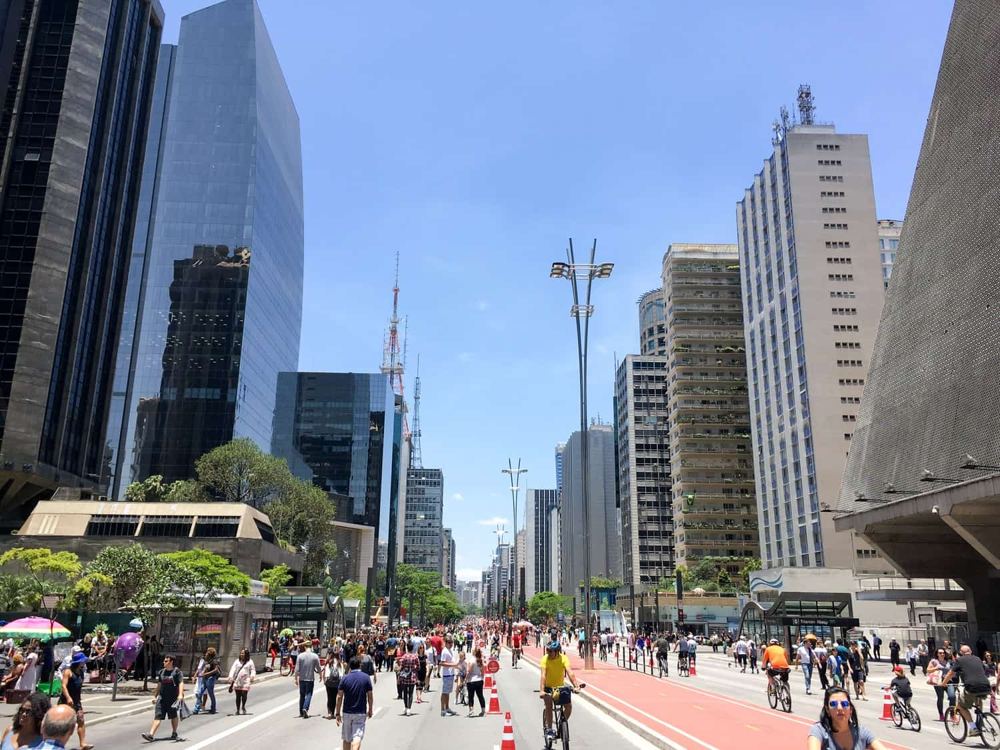
Avenida Brigadeiro Faria Lima anchors the western São Paulo corridor where most LatAm capital-markets business gets done. Within a three-kilometre radius of Faria Lima and Rua Iguatemi sit global investment banks, LatAm-focused asset managers, Big Four accounting practices and the investor-relations offices of Brazil’s largest issuers.
The corridor runs roughly five kilometres north-south from the Pinheiros River to the Iguatemi shopping centre. Its southern half between Avenida Cidade Jardim and the river holds the heaviest concentration of investment banking and asset management offices.
A senior traveller can schedule four bank meetings in one morning entirely on foot. That density is why Faria Lima ranked as São Paulo’s top business hub for banking and capital markets in 2026.
BTG Pactual, XP Investimentos, Itaú BBA, JP Morgan Brasil and Goldman Sachs Brasil all maintain major offices along the axis. The build-up accelerated around 2010 when capital-markets expansion pushed headquarters south from Avenida Paulista to Faria Lima.
Itaim Bibi adjoins Faria Lima to the north and east and functions as a mixed corporate-and-residential district. It has absorbed spillover demand from the banking corridor while offering the deepest hotel and premium-restaurant inventory in a single walkable radius.
For corporate travellers with meetings spread across Faria Lima, Vila Olímpia and Berrini, Itaim Bibi serves as the practical base. Faria Lima is described in travel rankings as the right default base for banking, asset management and top-tier law-firm meetings.
The district’s luxury hotel rates in 2026 run from BRL 1,500 to BRL 3,200 per night, equivalent to about US$265 to US$565. Faria Lima properties range from BRL 1,650 to BRL 3,400, roughly US$290 to US$600.
A five-day senior US-executive trip with chauffeur and client entertainment costs US$8,000 to US$14,000 before airfare. Premium-cabin flights from the United States add another US$4,000 to US$8,000.
B3, Brasil, Bolsa, Balcão is Brazil’s main securities and derivatives exchange, headquartered in São Paulo. It runs equity, fixed income, derivatives and OTC registration alongside data services.
About 358 listed companies were on B3 at the end of 2025, a low figure for an economy of Brazil’s size. No new stock market listings occurred on the exchange in 2025.
Over roughly the past decade, about 93 public tender offers nearly matched the number of initial public offerings. From early 2025 through April 2026, 21 companies left B3 through delistings.
Before this year, the last B3 IPO was the agricultural input company Vittia in September 2021. For four years and eight months after that, the domestic IPO window has remained shut.
B3 leadership and market analysts describe more than 100 Brazilian companies as IPO-ready. Corporate preparation is largely complete, but timing depends on macro conditions.
High domestic interest rates and depressed trading volumes are the key constraints. The pipeline is seen as pent-up supply that could release quickly if the Selic policy rate falls meaningfully.
Latin American IPO activity slowed sharply after the 2021 surge of 52 IPOs raising about US$16.2 billion. By 2024 only five IPOs raised roughly US$28 million, and the first half of 2025 brought just two small IPOs.
The average market capitalisation of B3-listed companies reached R$5.43 trillion in February 2026, approximately US$964 billion at the cited conversion. That marked a 28.2 percent year-on-year increase.
Foreign investors accounted for 60.2 percent of total B3 trading participation in February 2026. That was up from 58.3 percent in 2025.
The exchange has also registered growth in individual investors, though the most recent press figure dates from June 2023. That release highlighted a 34 percent growth in fixed-income investors and 23 percent growth in equity investors over the preceding 12 months.
For foreign institutions, São Paulo remains the operational centre for accessing Brazilian markets. The corridor’s law firms, accounting practices and custodians sit within walking distance of B3’s major participants.
The market-cap recovery in early 2026 suggests investor interest has not vanished. But the public equity ecosystem is still smaller than regional peers would expect from Brazil’s economic weight.
Nu Holdings Ltd., the parent of Nubank, reported 2025 revenue of US$15.8 billion and profit of US$2.9 billion in its Form 20-F filing with US securities regulators. The company serves 131 million customers across Brazil, Mexico and Colombia.
In Brazil alone, Nubank had 113 million customers in 2025 based on Central Bank of Brazil data. That made it the largest private financial institution in the country by number of customers.
The digital bank serves 62 percent of the Brazilian population with an activity rate of 86 percent. Its operational base sits within São Paulo’s broader fintech cluster, competing directly with incumbent lenders headquartered along Faria Lima.
The fintech boom has changed what being the financial capital means. Scale now builds through digital platforms and credit products rather than branch networks and investment-banking floors alone.
The contraction in B3 listings has not halted capital formation, which has shifted toward private credit and asset-management structures. Faria Lima hosts the LatAm-focused asset managers that allocate Brazilian credit and equity exposure for foreign institutions.
Private credit growth matters because Brazilian corporates now often fund themselves outside the public equity market. The 21 delistings since early 2025 reflect the same dynamic: fewer public issuers, more privately held or sponsor-owned businesses.
The pipeline of IPO-ready companies overlaps with private credit demand, as many firms that delayed listings now finance expansion with structured debt. Foreign investors seeking yield have moved into these instruments through São Paulo-based managers.
The B3 ecosystem still provides the registered infrastructure for much of this credit activity through its OTC and registration platforms. But the growth story for asset managers in 2026 is more fixed income and private credit than equity underwriting.
Mexico City and Miami both compete with São Paulo for Latin American financial headquarters and regional banking mandates. Mexico City benefits from proximity to the United States and Mexico’s own growing fintech and capital-markets activity.
Miami has attracted Latin American family offices, trading desks and private-credit firms seeking dollar-based operations and easier access to US capital. São Paulo remains the centre for local Brazilian markets, but regional hubs increasingly split functions across cities.
The Faria Lima corridor still holds what travel rankings call the densest concentration of capital-markets headquarters in Latin America. That standing comes from sheer local-market depth, not from housing every regional role.


