China Unveils ADANES AI Framework for Nuclear Energy

Chinese researchers have revealed a five-layer AI architecture to manage the entire nuclear energy life cycle, a move that signals a major shift in how nuclear infrastructure will be built and operated to meet surging power demand.
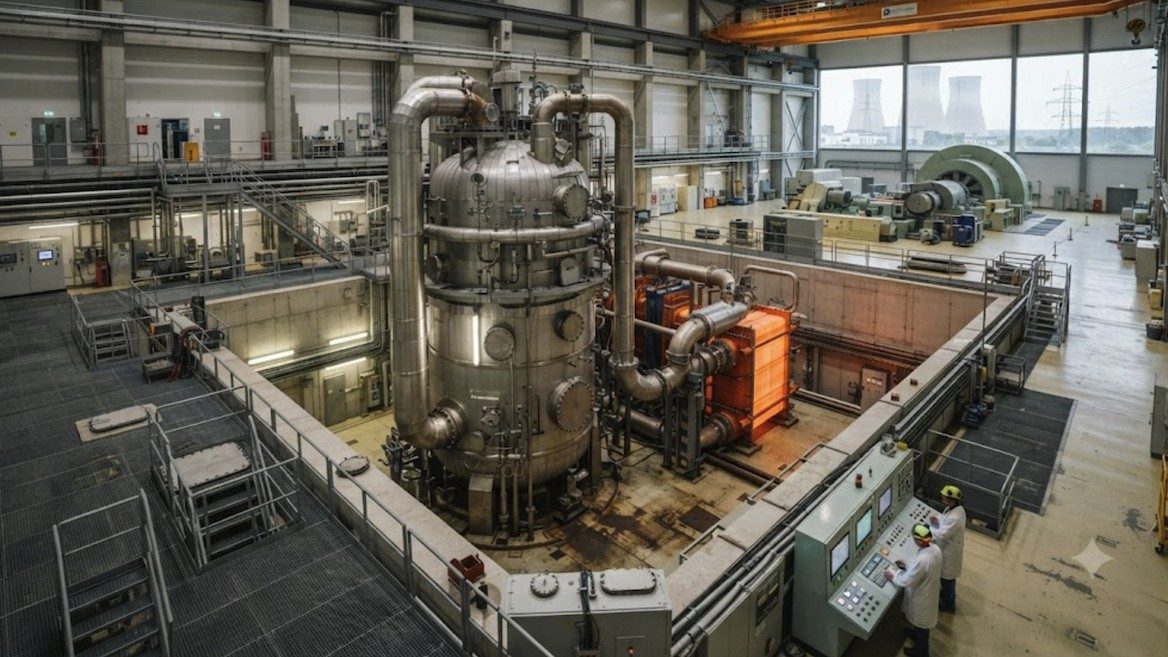
Researchers at the Chinese Academy of Sciences have introduced ADANES, the Accelerator-Driven Advanced Nuclear Energy System, aiming to embed artificial intelligence across every phase of nuclear power generation. Unveiled at the World Artificial Intelligence Conference in Shanghai, the framework relies on a structured technical approach. According to a recent report on the system, “The AI architecture consists of five layers — a unified data infrastructure, physics-native world models, physical-system control, intelligent-agent coordination and continuous evolution — embedding AI throughout the system's full life cycle, from design and commissioning to operation and maintenance.”
For infrastructure investors and utility executives, the system represents a potential solution to the nuclear sector's chronic cost and timeline overruns. By integrating AI from the initial design through operation, developers hope to streamline the complex engineering processes that have historically made new nuclear plants slow and expensive to build. Wang Shoujun, president of the Chinese Nuclear Society, noted that through ADANES, “AI will play a core role throughout the full life cycle of nuclear energy by improving quality, efficiency and safety.”
However, deploying opaque large language models in highly regulated energy environments presents a distinct hurdle. The inherent "black box" functionality of current AI models conflicts with stringent nuclear safety requirements, particularly the need to process operational signals and shut down reactors at the earliest stages of a mishap. The CAS researchers acknowledge this friction, stating the new system “fundamentally changes the safety logic that governs conventional nuclear reactors.” To satisfy regulatory demands for transparency, China is constructing a national-scale engineering verification platform to ensure the system's long-term stability.
The US response to nuclear bottlenecks
The push to digitize nuclear development is not isolated to China. In the United States, technology giants Microsoft and NVIDIA are targeting the sector's primary financial bottleneck: regulatory permitting. Their jointly developed toolkit uses digital twins for faster engineering solutions and employs generative AI specifically for document drafting and gap analysis during the licensing phase.
This technological convergence is driven by a fundamental market dynamic. The rapid expansion of generative AI is projected to create electricity demand that far outpaces current grid additions. Consequently, Silicon Valley capital is actively funding advanced nuclear technologies, treating next-generation reactors as the only viable long-term power source for massive data centers.