Finland's giant sand battery cuts heating emissions 70%
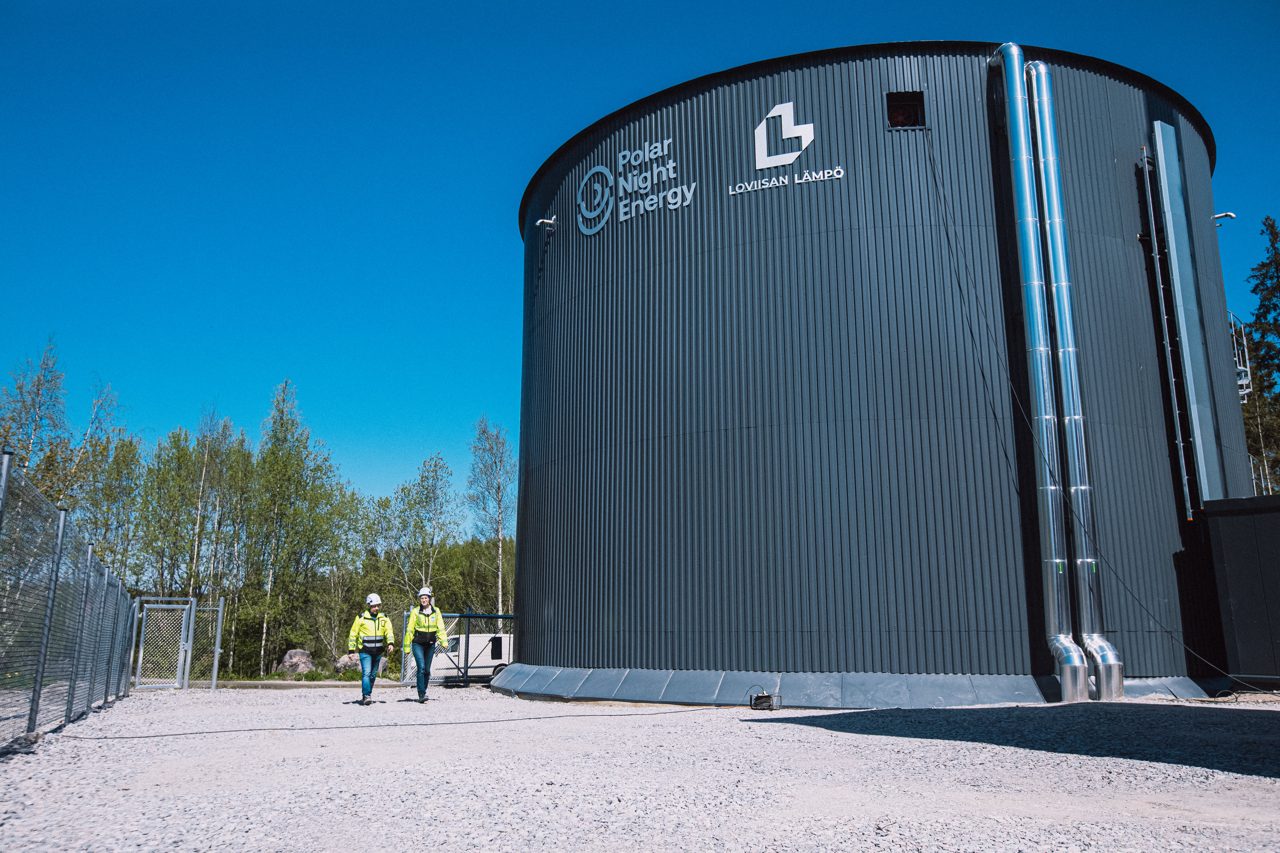
A Finnish district heating network has deployed the world's largest commercial sand battery, slashing emissions and proving the financial viability of thermal storage that bypasses critical mineral supply chains.
A district heating company in southern Finland has commissioned the world's largest commercial sand battery, a 100-megawatt-hour thermal storage facility that has already cut the local network's greenhouse gas emissions by almost 70%.
Built by Polar Night Energy for Loviisan Lämpö, the 13-meter-tall silo in the town of Pornainen holds 2,000 metric tons of crushed soapstone. It replaces a system that previously relied heavily on burning oil and wood chips. The facility is roughly ten times larger than a previous iteration launched in 2022, providing enough stored heat for 5,000 residents to last a week in winter or a month in summer.
For energy markets, the core financial attraction of electrothermal storage is grid arbitrage. The system absorbs cheap, excess wind and solar power to heat the heavily insulated material, trapping that energy for days or weeks before discharging it through heat exchangers. "That delay is your business advantage because you can heat up the sand when the electricity is cheap, and you use the steam when normally it would be very expensive," said Annette Höglund-Dönnes, chief commercial officer of Polar Night Energy.
This operational model bypasses the volatile supply chains constraining the lithium-ion market. "We're changing from a world where big power plants were doing the energy production to where solar and wind are producing the energy, then we need a massive amount of storage," said Tommi Eronen, CEO of Polar Night Energy. "Hopefully a big portion of those storages could be sand battery-type of storages where we don't need rare earth materials."
Jan Rosenow, a professor of energy and climate policy at the University of Oxford, noted that sand batteries can hold energy far longer than the typical two-to-four-hour window of chemical batteries. The transition has already altered Loviisan Lämpö's fuel mix, reducing wood chip consumption by 60% while keeping an existing plant as a backup for peak loads.
Mikko Paajanen, CEO of Loviisan Lämpö, said the company aims to derive 55% to 60% of its heating from the battery in the first few months of this year, up from roughly 30% in 2025. "The main thing is that we can separate the electricity procurement from the district heating production," Paajanen said. "So, we can utilize the low spot prices very well."
Despite inbound interest from "every single continent," particularly from communities reliant on coal and oil, scaling the technology faces structural limits. Sand batteries currently cannot efficiently convert stored heat back into electricity, restricting their use to thermal networks, and their energy density lags conventional batteries. Finland's Climate Minister Sari Multala noted, however, that developers are exploring future electricity generation capabilities, a breakthrough that would dramatically expand the technology's addressable market.